
Indian Plate Splits After 140 Million Years: A Deep Crisis Under the Himalayas
Can you imagine a time when the world’s highest peaks, the Himalayas, were submerged beneath a vast ocean? This is not a myth or a product of imagination, but one of the most remarkable truths about Earth’s history. Around 140 million years ago, the geography of our planet looked very different from what we see today. At that time, India formed part of a vast southern supercontinent known as Gondwanaland, located deep in the Southern Hemisphere.What followed was a dramatic geological upheaval that permanently reshaped the face of the planet. This is the story of the moment when India broke away from its ancient landmass and began an extraordinary journey northward. During this movement, the Tethys Sea gradually disappeared, and a portion of the Earth’s crust was pushed upward, eventually giving rise to the landscape we now recognize as India and Nepal.Why Did India Move North at Such Extraordinary Speed?Around 140 million years ago, India was firmly embedded within Gondwanaland. It later broke away and began drifting northward in what was far from an ordinary continental migration. Scientists estimate that the Indian tectonic plate traveled nearly 9,000 kilometers over the course of 100 million years.What makes this journey particularly remarkable is its speed. While most continental plates moved slowly and steadily, the Indian plate advanced northward at an astonishing rate of about 18 to 20 centimeters per year. Researchers believe that this unusual velocity was largely due to the structure of India’s lithosphere, the rocky outer layer of the Earth. At only about 100 kilometers thick, it was significantly thinner and therefore lighter than many other continental plates. This reduced weight allowed the Indian plate to move rapidly toward the Eurasian plate, continuing its relentless journey until the two finally collided.How Did the Tethys Sea Rise to the Roof of the World?Standing in the path of India’s relentless advance was the ancient Tethys Sea, a vast body of water that once separated India from Asia. When the Indian plate collided with the Eurasian plate around 50 million years ago, the impact was so powerful that it gradually closed the Tethys Sea and brought it to an end.The collision compressed the Earth’s crust and forced it upward. Layers of seafloor sediments were folded and lifted, eventually giving rise to the highest mountain range on Earth, the Himalayas. This remarkable transformation explains why marine fossils can still be found at such extreme altitudes today.Among the most striking examples are the Shaligram stones found in Nepal’s Kali Gandaki River. These stones are fossilized ammonites, marine creatures that once thrived in the Tethys Sea. Their presence high in the mountains offers compelling evidence that the peaks of India and Nepal were once part of the ocean floor.Mountain building did not end with the rise of the Himalayas. As these towering ranges took shape, erosion began its quiet yet powerful work. Broken rock, debris, and sediment were gradually carried downhill by rivers and rainfall, collecting at the base of the mountains.Over time, these deposits gave rise to the Shivalik Hills, known in Nepal as the Chure Range. They form the youngest and outermost ranges of the Himalayas, stretching from the Yamuna and Markanda river exit points in India to southern Nepal. Geological studies show that the Shivaliks are made of sediments eroded from the rising Himalayas themselves, forming a natural geological link that connects India and Nepal through a shared tectonic history.Scientists continue to uncover clues preserved deep within Himalayan rock layers that date back to the Jurassic and Cretaceous periods. Studies conducted in India’s Spiti region and across Nepal’s Himalayan belt have revealed extensive deposits of ammonites and other marine fossils.These remains mark the southern boundary of the ancient Tethys Sea. Whether discovered in Spiti or in the mountains of Nepal, the fossils tell the same story: this entire region once lay beneath the waters of a vast ocean. The land that now rises toward the sky is, in fact, the solidified memory of that ancient sea.What Recent Research from January 2026 Reveals?Recent findings released in January 2026 have added a new dimension to our understanding of Himalayan geology. Data presented at the American Geophysical Union meeting in San Francisco suggests that the Indian plate remains geologically active, though in a surprising and previously unrecognized way.According to these findings, the Indian plate is fracturing beneath Tibet. Instead of breaking vertically, it appears to be peeling apart horizontally, much like layers of plywood separating from one another. Scientists refer to this process as delamination.In this process, the upper portion of the plate continues to support the Tibetan Plateau, while the denser lower section breaks away and sinks into the Earth’s mantle. This discovery confirms that the formation of the Himalayas is not merely a completed chapter of the past, but an ongoing geological process that continues to shape the landscapes of India and Nepal.The journey that began 140 million years ago is still unfolding. India’s rapid northward movement not only brought an end to the Tethys Sea but also gave rise to the highest mountains on Earth. The Shaligram fossils of Nepal and the marine remains preserved in India’s high altitude rocks stand as silent witnesses to a time when this land lay beneath the sea.The Shivalik Hills and the continuing tectonic movements make one truth unmistakable: although India and Nepal may appear as separate nations on a political map, they rest upon the same immense slab of the Earth’s crust. Their mountains, rivers, and landscapes are the legacy of a single monumental collision that forever reshaped the face of the planet.Sources:https://tinyurl.com/29pna3fehttps://tinyurl.com/26yxtlozhttps://tinyurl.com/28qpbnsahttps://tinyurl.com/292pejeghttps://tinyurl.com/29glet46https://tinyurl.com/22tekrqdhttps://tinyurl.com/2c2okp2e
The Lens of History: Early Photography in India and Nepal
In the mid nineteenth century, as the worlds of science and art were filled with new experiments, one invention forever changed how history was recorded. This invention was the camera. Between 1850 and 1900, a dramatic shift occurred in the mountains of North India and Nepal. This change was not brought about by cannons or swords but by heavy wooden boxes filled with glass plates and chemicals. Before this time, the image of the Himalayas was limited to paintings or travel journals, but the arrival of photography showed the world a new and authentic face of these mountains and the people living there. This article tells the story of an era when British travelers like Samuel Bourne captured inaccessible peaks through their lenses and Indian artists like Raja Lala Deen Dayal created history on their own terms. It is also the tale of the forbidden valley of Nepal, where rulers turned this new technology into a symbol of their power.How did Samuel Bourne bring the remote Himalayan peaks to the world?When we look at old black and white photographs of the Himalayas showing snow covered peaks and deep valleys, we often forget the hard work behind them. British photographer Samuel Bourne, who arrived in India in 1863, accomplished this feat. At that time, photography was not as easy as it is today. It was the era of the wet plate collodion process, which required heavy glass plates, chemicals, and a portable darkroom tent. Bourne made three major and dangerous journeys into the Himalayas with this bulky equipment. He even traveled to and photographed the Manirung Pass at an elevation of 18,600 feet. His photographs gave people in Britain and Europe their first true sense of the grandeur of the Himalayas. For them, the mountains were not just rocks but a picturesque world waiting to be explored and conquered.Did Bourne and Shepherd provide a new lens to view India?Samuel Bourne partnered with Charles Shepherd to establish the Bourne and Shepherd studio in Shimla and Calcutta. It became one of the oldest photography studios in the world. This studio captured more than just mountains because it documented the architecture, landscapes, and daily life of all of North India. Their photographs were not just memories but became documents of the expansion and power of the British Raj. They presented India as a mysterious and beautiful country that was a source of pride for colonial rulers. These images created a specific vision of India in the Western world that lasted for many decades. In these photos, India was often shown as an untouched and vast territory that served as a perfect backdrop for the exploration and administration of the British Empire.How did Lala Deen Dayal present an Indian perspective in photography?While foreign photographers like Samuel Bourne were looking at India from an outside perspective, an Indian artist turned the camera into his own tool. This was Raja Lala Deen Dayal. He began his photography career in the mid 1870s and quickly became the most famous Indian photographer of his time. He was appointed as a photographer for the Nizam of Hyderabad and later for Queen Victoria. Deen Dayal did not just take pictures of buildings because he captured the lives of Indian kings, nobles, and their royal courts with great intimacy. His work possessed a sense of dignity and familiarity that was often missing from the work of foreign photographers. He showed that Indian society was not just a land of snake charmers or ruins but home to a rich and modernizing culture. What was the role of Indian photographers in royal courts?The work of photographers like Lala Deen Dayal was not just about taking pictures because they were preserving history within an Indian context. There is a clear difference between the work of indigenous photographers and colonial ones. While British photographers often portrayed India as a subordinate or exotic land, Indian photographers depicted their patrons such as kings and emperors with power and authority. In the portraits by Lala Deen Dayal, the Indian elite appear full of confidence. He also used his camera to capture harsh realities like famines and relief efforts, which reflects the social concerns of that era. In this way, he changed the language of photography and made it a medium for self expression and self respect.Who took the first photographs of the forbidden valley of Nepal?While photography was spreading rapidly in India, Nepal remained almost entirely closed to the outside world. Very few foreigners were allowed to enter the Kathmandu Valley. This raises the question of who took the first photographs of Nepal and how. Between 1863 and 1865, Clarence Comyn Taylor, the Assistant Resident at the British Residency in Kathmandu, took some of the earliest images of the country. Since professional photographers could not enter Nepal, the responsibility fell on the shoulders of amateur British officials like Taylor. He captured the temples of Kathmandu, Newar architecture, and the local people. These photographs are priceless today because they are the only visual testimony of a time when Nepal was hidden from the eyes of the world.How did these early photos give a voice to ordinary people?Looking deeply at these early photographs reveals that the motive was not just to capture beauty. These images were often part of a larger ethnographic project aimed at classifying and understanding different castes and communities. In these photos from the 1860s, we see ordinary Nepali citizens such as farmers, soldiers, and Newar women for the first time. Before this, the history of Nepal existed only in written documents or religious paintings. Photography gave the common man a place in the pages of history for the first time. These images tell us what people looked like, what they wore, and what their surroundings were like. This marked the beginning of the visual history of Nepal.How did the Rana rulers turn photography into a symbol of prestige?Although photography entered Nepal through foreigners, the ruling class known as the Ranas adopted it very quickly. Jung Bahadur Rana recognized the power of photography during his visit to Europe. Soon, the practice of photography began in the courts of Kathmandu. The Rana rulers did not just have formal portraits taken because they also appointed special photographers in their courts. These photographs followed the style of Indian royal families with elaborate clothing, serious poses, and grand backgrounds. For the Ranas, photography was not just a hobby but a way to display their modernity and sovereignty. They used it to strengthen their political legitimacy and present themselves as powerful rulers.How do photographs shape our political memory?When we look at these old photographs today, we must realize they are not just scraps of old paper. These early photographic archives play a vital role in shaping political imagination and memory. In the context of Nepal and India, these images are keys to understanding the politics, power balance, and social structure of that era. They tell us how history was written or presented. Whether it was the Himalayan views of Bourne or the portraits of the Ranas, every photograph had a purpose. Today, these images are an important resource for researchers and historians as they help us understand how people in the past saw themselves and their world.Sources:https://tinyurl.com/262f6jsnhttps://tinyurl.com/25sncn62https://tinyurl.com/2y3cefz4https://tinyurl.com/222ohn7ohttps://tinyurl.com/2dpww82jhttps://tinyurl.com/227kf4b8https://tinyurl.com/2xhf6mfohttps://tinyurl.com/2xjjeq2v
Is the Unique Himalayan Red Panda the True Living Fossil of India and Nepal?
Deep within the fog shrouded bamboo forests of the Himalayas lives a mysterious creature that recently caused a stir in the scientific community. At the end of 2025, the rare Red Panda, also known as the Firefox, was spotted again in the Dhaulagiri region of western Nepal. This sighting reaffirmed the critical importance of vast forest corridors for these animals. However, the most shocking revelation lay hidden in their DNA. Historical scientific research has now proven that the Himalayan Red Panda found in India and Nepal is not a common variety but a genetically distinct species from the one found in China. No wall separates these two species; instead, the massive Brahmaputra River has kept them apart for millions of years. This scientific discovery highlights that the Red Panda of India and Nepal is a unique part of evolutionary history, making its protection a top priority for both nations.What unique features help the Red Panda hide and eat bamboo?The Red Panda is a biological marvel. One of its most fascinating traits is a pseudo thumb, which is actually an extension of the wrist bone that allows it to grip bamboo stalks firmly. Its primary diet consists of tender bamboo leaves and shoots, which it chews using powerful jaws. Since bamboo is low in nutrients, the Red Panda spends most of its day eating to maintain energy. Its thick, reddish brown fur provides perfect camouflage among the red and brown mossy trees of the Himalayas, keeping it safe from predators. The long, bushy tail helps maintain balance while moving through trees and also acts as a warm blanket, covering its face during freezing temperatures. By what names is this creature known in the cultures of India and Nepal?In the Himalayan regions, this animal is more than just wildlife; it is a sacred part of local culture and faith. In the forests and villages of Nepal, it is known as Habre. In India, it is locally called Ponya. Experts believe the world famous word Panda actually originated from this Indian term Ponya, which means a bamboo eating creature. Folk tales from mountain communities in India and Nepal depict the Red Panda as a symbol of good luck and a positive omen. Local people believe that any forest inhabited by this creature is balanced and healthy. Today, community based tourism is being encouraged around this animal in Nepal, where locals act as guardians of these rare beings and educate visitors about their significance.How is the threat of extinction currently affecting the Red Panda?The greatest threat facing the Red Panda today is not predators but inbreeding. In Indian states like Sikkim and Arunachal Pradesh, deforestation and road construction have fragmented their habitats into small patches. When Red Panda families are confined to tiny forest pockets, they cannot meet other groups. Repeated breeding within the same family weakens their genetic strength and reduces their ability to fight diseases. Scientists call this silent extinction. It is a slow poison that hollows out the species without making any noise. If the forest corridors connecting these patches are destroyed, these shy creatures will soon be lost to history.How does the Kanchenjunga landscape serve as a vital genetic bridge?To save these animals from silent extinction, the Kanchenjunga landscape along the borders of India and Nepal plays a crucial role. This area acts as a genetic bridge connecting the Singalila National Park in India to the forests of the Ilam district in Nepal. Recent research indicates that the unrestricted movement of Red Pandas between these two countries is essential for maintaining a healthy gene flow. If the forests between Singalila and Ilam are cleared, this genetic bridge will break. Researchers have been monitoring the population and genetic flow in this border region. This study emphasizes that the future of the Himalayan Red Panda does not rest with a single nation but depends on how both countries work together to protect these forest corridors.How is science helping to save this living fossil in Darjeeling?As natural habitats face constant threats, science has found a futuristic way to protect these creatures. At the Padmaja Naidu Himalayan Zoological Park in Darjeeling, India, an advanced conservation breeding program is underway. Scientists here are doing more than just caring for the animals; they are utilizing a modern technique called biobanking. This involves freezing the DNA and genetic material of Red Pandas at extremely low temperatures to keep them safe. The DNA of pandas living in the zoo is carefully analyzed to ensure that any offspring born are genetically robust. This unique blend of science and conservation ensures that this living fossil of evolution does not vanish from the Earth forever.Sources:https://tinyurl.com/22vehyrnhttps://tinyurl.com/2f2769xbhttps://tinyurl.com/27ujyhubhttps://tinyurl.com/24rw6u2ehttps://tinyurl.com/24fedhc8https://tinyurl.com/27goqjwnhttps://tinyurl.com/2atl5ll8
Indian Plate Splits After 140 Million Years: A Deep Crisis Under the Himalayas
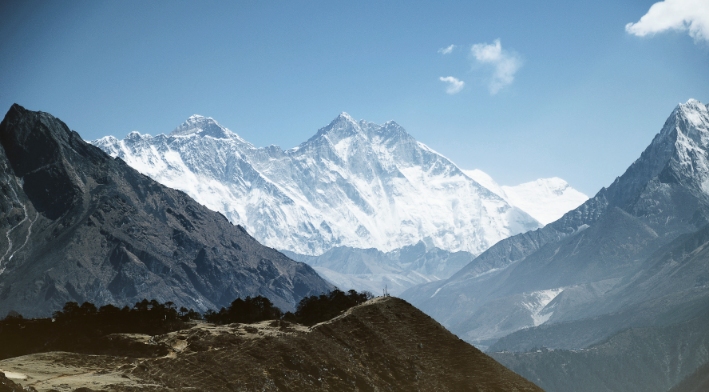
Can you imagine a time when the world’s highest peaks, the Himalayas, were submerged beneath a vast ocean? This is not a myth or a product of imagination, but one of the most remarkable truths about Earth’s history. Around 140 million years ago, the geography of our planet looked very different from what we see today. At that time, India formed part of a vast southern supercontinent known as Gondwanaland, located deep in the Southern Hemisphere.
What followed was a dramatic geological upheaval that permanently reshaped the face of the planet. This is the story of the moment when India broke away from its ancient landmass and began an extraordinary journey northward. During this movement, the Tethys Sea gradually disappeared, and a portion of the Earth’s crust was pushed upward, eventually giving rise to the landscape we now recognize as India and Nepal.
Why Did India Move North at Such Extraordinary Speed?
Around 140 million years ago, India was firmly embedded within Gondwanaland. It later broke away and began drifting northward in what was far from an ordinary continental migration. Scientists estimate that the Indian tectonic plate traveled nearly 9,000 kilometers over the course of 100 million years.
What makes this journey particularly remarkable is its speed. While most continental plates moved slowly and steadily, the Indian plate advanced northward at an astonishing rate of about 18 to 20 centimeters per year. Researchers believe that this unusual velocity was largely due to the structure of India’s lithosphere, the rocky outer layer of the Earth. At only about 100 kilometers thick, it was significantly thinner and therefore lighter than many other continental plates. This reduced weight allowed the Indian plate to move rapidly toward the Eurasian plate, continuing its relentless journey until the two finally collided.
How Did the Tethys Sea Rise to the Roof of the World?
Standing in the path of India’s relentless advance was the ancient Tethys Sea, a vast body of water that once separated India from Asia. When the Indian plate collided with the Eurasian plate around 50 million years ago, the impact was so powerful that it gradually closed the Tethys Sea and brought it to an end.
The collision compressed the Earth’s crust and forced it upward. Layers of seafloor sediments were folded and lifted, eventually giving rise to the highest mountain range on Earth, the Himalayas. This remarkable transformation explains why marine fossils can still be found at such extreme altitudes today.
Among the most striking examples are the Shaligram stones found in Nepal’s Kali Gandaki River. These stones are fossilized ammonites, marine creatures that once thrived in the Tethys Sea. Their presence high in the mountains offers compelling evidence that the peaks of India and Nepal were once part of the ocean floor.
Mountain building did not end with the rise of the Himalayas. As these towering ranges took shape, erosion began its quiet yet powerful work. Broken rock, debris, and sediment were gradually carried downhill by rivers and rainfall, collecting at the base of the mountains.
Over time, these deposits gave rise to the Shivalik Hills, known in Nepal as the Chure Range. They form the youngest and outermost ranges of the Himalayas, stretching from the Yamuna and Markanda river exit points in India to southern Nepal. Geological studies show that the Shivaliks are made of sediments eroded from the rising Himalayas themselves, forming a natural geological link that connects India and Nepal through a shared tectonic history.
Scientists continue to uncover clues preserved deep within Himalayan rock layers that date back to the Jurassic and Cretaceous periods. Studies conducted in India’s Spiti region and across Nepal’s Himalayan belt have revealed extensive deposits of ammonites and other marine fossils.
These remains mark the southern boundary of the ancient Tethys Sea. Whether discovered in Spiti or in the mountains of Nepal, the fossils tell the same story: this entire region once lay beneath the waters of a vast ocean. The land that now rises toward the sky is, in fact, the solidified memory of that ancient sea.

What Recent Research from January 2026 Reveals?
Recent findings released in January 2026 have added a new dimension to our understanding of Himalayan geology. Data presented at the American Geophysical Union meeting in San Francisco suggests that the Indian plate remains geologically active, though in a surprising and previously unrecognized way.
According to these findings, the Indian plate is fracturing beneath Tibet. Instead of breaking vertically, it appears to be peeling apart horizontally, much like layers of plywood separating from one another. Scientists refer to this process as delamination.
In this process, the upper portion of the plate continues to support the Tibetan Plateau, while the denser lower section breaks away and sinks into the Earth’s mantle. This discovery confirms that the formation of the Himalayas is not merely a completed chapter of the past, but an ongoing geological process that continues to shape the landscapes of India and Nepal.
The journey that began 140 million years ago is still unfolding. India’s rapid northward movement not only brought an end to the Tethys Sea but also gave rise to the highest mountains on Earth. The Shaligram fossils of Nepal and the marine remains preserved in India’s high altitude rocks stand as silent witnesses to a time when this land lay beneath the sea.
The Shivalik Hills and the continuing tectonic movements make one truth unmistakable: although India and Nepal may appear as separate nations on a political map, they rest upon the same immense slab of the Earth’s crust. Their mountains, rivers, and landscapes are the legacy of a single monumental collision that forever reshaped the face of the planet.
Sources:
https://tinyurl.com/29pna3fe
https://tinyurl.com/26yxtloz
https://tinyurl.com/28qpbnsa
https://tinyurl.com/292pejeg
https://tinyurl.com/29glet46
https://tinyurl.com/22tekrqd
https://tinyurl.com/2c2okp2e
The Lens of History: Early Photography in India and Nepal
In the mid nineteenth century, as the worlds of science and art were filled with new experiments, one invention forever changed how history was recorded. This invention was the camera. Between 1850 and 1900, a dramatic shift occurred in the mountains of North India and Nepal. This change was not brought about by cannons or swords but by heavy wooden boxes filled with glass plates and chemicals. Before this time, the image of the Himalayas was limited to paintings or travel journals, but the arrival of photography showed the world a new and authentic face of these mountains and the people living there. This article tells the story of an era when British travelers like Samuel Bourne captured inaccessible peaks through their lenses and Indian artists like Raja Lala Deen Dayal created history on their own terms. It is also the tale of the forbidden valley of Nepal, where rulers turned this new technology into a symbol of their power.
How did Samuel Bourne bring the remote Himalayan peaks to the world?
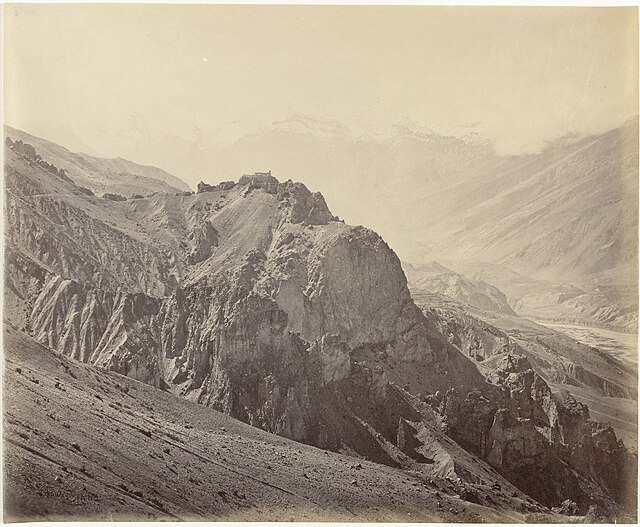
When we look at old black and white photographs of the Himalayas showing snow covered peaks and deep valleys, we often forget the hard work behind them. British photographer Samuel Bourne, who arrived in India in 1863, accomplished this feat. At that time, photography was not as easy as it is today. It was the era of the wet plate collodion process, which required heavy glass plates, chemicals, and a portable darkroom tent. Bourne made three major and dangerous journeys into the Himalayas with this bulky equipment. He even traveled to and photographed the Manirung Pass at an elevation of 18,600 feet. His photographs gave people in Britain and Europe their first true sense of the grandeur of the Himalayas. For them, the mountains were not just rocks but a picturesque world waiting to be explored and conquered.
Did Bourne and Shepherd provide a new lens to view India?
Samuel Bourne partnered with Charles Shepherd to establish the Bourne and Shepherd studio in Shimla and Calcutta. It became one of the oldest photography studios in the world. This studio captured more than just mountains because it documented the architecture, landscapes, and daily life of all of North India. Their photographs were not just memories but became documents of the expansion and power of the British Raj. They presented India as a mysterious and beautiful country that was a source of pride for colonial rulers. These images created a specific vision of India in the Western world that lasted for many decades. In these photos, India was often shown as an untouched and vast territory that served as a perfect backdrop for the exploration and administration of the British Empire.
How did Lala Deen Dayal present an Indian perspective in photography?
While foreign photographers like Samuel Bourne were looking at India from an outside perspective, an Indian artist turned the camera into his own tool. This was Raja Lala Deen Dayal. He began his photography career in the mid 1870s and quickly became the most famous Indian photographer of his time. He was appointed as a photographer for the Nizam of Hyderabad and later for Queen Victoria. Deen Dayal did not just take pictures of buildings because he captured the lives of Indian kings, nobles, and their royal courts with great intimacy. His work possessed a sense of dignity and familiarity that was often missing from the work of foreign photographers. He showed that Indian society was not just a land of snake charmers or ruins but home to a rich and modernizing culture.
What was the role of Indian photographers in royal courts?
The work of photographers like Lala Deen Dayal was not just about taking pictures because they were preserving history within an Indian context. There is a clear difference between the work of indigenous photographers and colonial ones. While British photographers often portrayed India as a subordinate or exotic land, Indian photographers depicted their patrons such as kings and emperors with power and authority. In the portraits by Lala Deen Dayal, the Indian elite appear full of confidence. He also used his camera to capture harsh realities like famines and relief efforts, which reflects the social concerns of that era. In this way, he changed the language of photography and made it a medium for self expression and self respect.
Who took the first photographs of the forbidden valley of Nepal?
While photography was spreading rapidly in India, Nepal remained almost entirely closed to the outside world. Very few foreigners were allowed to enter the Kathmandu Valley. This raises the question of who took the first photographs of Nepal and how. Between 1863 and 1865, Clarence Comyn Taylor, the Assistant Resident at the British Residency in Kathmandu, took some of the earliest images of the country. Since professional photographers could not enter Nepal, the responsibility fell on the shoulders of amateur British officials like Taylor. He captured the temples of Kathmandu, Newar architecture, and the local people. These photographs are priceless today because they are the only visual testimony of a time when Nepal was hidden from the eyes of the world.
How did these early photos give a voice to ordinary people?
Looking deeply at these early photographs reveals that the motive was not just to capture beauty. These images were often part of a larger ethnographic project aimed at classifying and understanding different castes and communities. In these photos from the 1860s, we see ordinary Nepali citizens such as farmers, soldiers, and Newar women for the first time. Before this, the history of Nepal existed only in written documents or religious paintings. Photography gave the common man a place in the pages of history for the first time. These images tell us what people looked like, what they wore, and what their surroundings were like. This marked the beginning of the visual history of Nepal.
How did the Rana rulers turn photography into a symbol of prestige?
Although photography entered Nepal through foreigners, the ruling class known as the Ranas adopted it very quickly. Jung Bahadur Rana recognized the power of photography during his visit to Europe. Soon, the practice of photography began in the courts of Kathmandu. The Rana rulers did not just have formal portraits taken because they also appointed special photographers in their courts. These photographs followed the style of Indian royal families with elaborate clothing, serious poses, and grand backgrounds. For the Ranas, photography was not just a hobby but a way to display their modernity and sovereignty. They used it to strengthen their political legitimacy and present themselves as powerful rulers.
How do photographs shape our political memory?
When we look at these old photographs today, we must realize they are not just scraps of old paper. These early photographic archives play a vital role in shaping political imagination and memory. In the context of Nepal and India, these images are keys to understanding the politics, power balance, and social structure of that era. They tell us how history was written or presented. Whether it was the Himalayan views of Bourne or the portraits of the Ranas, every photograph had a purpose. Today, these images are an important resource for researchers and historians as they help us understand how people in the past saw themselves and their world.
Sources:
https://tinyurl.com/262f6jsn
https://tinyurl.com/25sncn62
https://tinyurl.com/2y3cefz4
https://tinyurl.com/222ohn7o
https://tinyurl.com/2dpww82j
https://tinyurl.com/227kf4b8
https://tinyurl.com/2xhf6mfo
https://tinyurl.com/2xjjeq2v
Is the Unique Himalayan Red Panda the True Living Fossil of India and Nepal?

Deep within the fog shrouded bamboo forests of the Himalayas lives a mysterious creature that recently caused a stir in the scientific community. At the end of 2025, the rare Red Panda, also known as the Firefox, was spotted again in the Dhaulagiri region of western Nepal. This sighting reaffirmed the critical importance of vast forest corridors for these animals. However, the most shocking revelation lay hidden in their DNA. Historical scientific research has now proven that the Himalayan Red Panda found in India and Nepal is not a common variety but a genetically distinct species from the one found in China. No wall separates these two species; instead, the massive Brahmaputra River has kept them apart for millions of years. This scientific discovery highlights that the Red Panda of India and Nepal is a unique part of evolutionary history, making its protection a top priority for both nations.
What unique features help the Red Panda hide and eat bamboo?
The Red Panda is a biological marvel. One of its most fascinating traits is a pseudo thumb, which is actually an extension of the wrist bone that allows it to grip bamboo stalks firmly. Its primary diet consists of tender bamboo leaves and shoots, which it chews using powerful jaws. Since bamboo is low in nutrients, the Red Panda spends most of its day eating to maintain energy. Its thick, reddish brown fur provides perfect camouflage among the red and brown mossy trees of the Himalayas, keeping it safe from predators. The long, bushy tail helps maintain balance while moving through trees and also acts as a warm blanket, covering its face during freezing temperatures.

By what names is this creature known in the cultures of India and Nepal?
In the Himalayan regions, this animal is more than just wildlife; it is a sacred part of local culture and faith. In the forests and villages of Nepal, it is known as Habre. In India, it is locally called Ponya. Experts believe the world famous word Panda actually originated from this Indian term Ponya, which means a bamboo eating creature. Folk tales from mountain communities in India and Nepal depict the Red Panda as a symbol of good luck and a positive omen. Local people believe that any forest inhabited by this creature is balanced and healthy. Today, community based tourism is being encouraged around this animal in Nepal, where locals act as guardians of these rare beings and educate visitors about their significance.
How is the threat of extinction currently affecting the Red Panda?
The greatest threat facing the Red Panda today is not predators but inbreeding. In Indian states like Sikkim and Arunachal Pradesh, deforestation and road construction have fragmented their habitats into small patches. When Red Panda families are confined to tiny forest pockets, they cannot meet other groups. Repeated breeding within the same family weakens their genetic strength and reduces their ability to fight diseases. Scientists call this silent extinction. It is a slow poison that hollows out the species without making any noise. If the forest corridors connecting these patches are destroyed, these shy creatures will soon be lost to history.
How does the Kanchenjunga landscape serve as a vital genetic bridge?
To save these animals from silent extinction, the Kanchenjunga landscape along the borders of India and Nepal plays a crucial role. This area acts as a genetic bridge connecting the Singalila National Park in India to the forests of the Ilam district in Nepal. Recent research indicates that the unrestricted movement of Red Pandas between these two countries is essential for maintaining a healthy gene flow. If the forests between Singalila and Ilam are cleared, this genetic bridge will break. Researchers have been monitoring the population and genetic flow in this border region. This study emphasizes that the future of the Himalayan Red Panda does not rest with a single nation but depends on how both countries work together to protect these forest corridors.
How is science helping to save this living fossil in Darjeeling?
As natural habitats face constant threats, science has found a futuristic way to protect these creatures. At the Padmaja Naidu Himalayan Zoological Park in Darjeeling, India, an advanced conservation breeding program is underway. Scientists here are doing more than just caring for the animals; they are utilizing a modern technique called biobanking. This involves freezing the DNA and genetic material of Red Pandas at extremely low temperatures to keep them safe. The DNA of pandas living in the zoo is carefully analyzed to ensure that any offspring born are genetically robust. This unique blend of science and conservation ensures that this living fossil of evolution does not vanish from the Earth forever.
Sources:
https://tinyurl.com/22vehyrn
https://tinyurl.com/2f2769xb
https://tinyurl.com/27ujyhub
https://tinyurl.com/24rw6u2e
https://tinyurl.com/24fedhc8
https://tinyurl.com/27goqjwn
https://tinyurl.com/2atl5ll8
Culture


Nature


Origin : 4 Bn BCE to 0.2 Mn BCE

People - 40000 BCE to 10000 BCE

Civilization : 10000 BCE to 2000 BCE

Settlements : 2000 BCE to 600 BCE

Age of Religion : 600 BCE to 300 CE

Small Kingdoms : 300 CE to 1000 CE

Early Medieval : 1000 CE to 1450 CE

Medieval : 1450 CE to 1780 CE

Colonization And World Wars : 1780 CE to 1947 CE

Modern State : 1947 to Now


Pottery to Glass to Jewellery

Weapons and Toys

Locomotion and Exercise/Gyms

Communication and IT Gadgets

Homes - Interiors/Chairs/Carpets

Architecture I - Exteriors-Buildings

Architecture II - Office/Work-Tools

Urbanization - Towns/Energy

Concept I - Measurement Tools (Paper/Watch)

Concept II - Identity of Citizen


Knowledge By Comparison A.I.
Encyclopedia - AI Reports (Latest Data Updated)
Countries
World Encyclopedia
The Czech Republic is divided into 14 regions, including Prague City, which falls within Central Bohemia.
North Zone
South Zone
West Zone
East Zone
Central Zone
North East Zone
Union Territories Zone
Nepal Data Analytics

India Data Analytics